
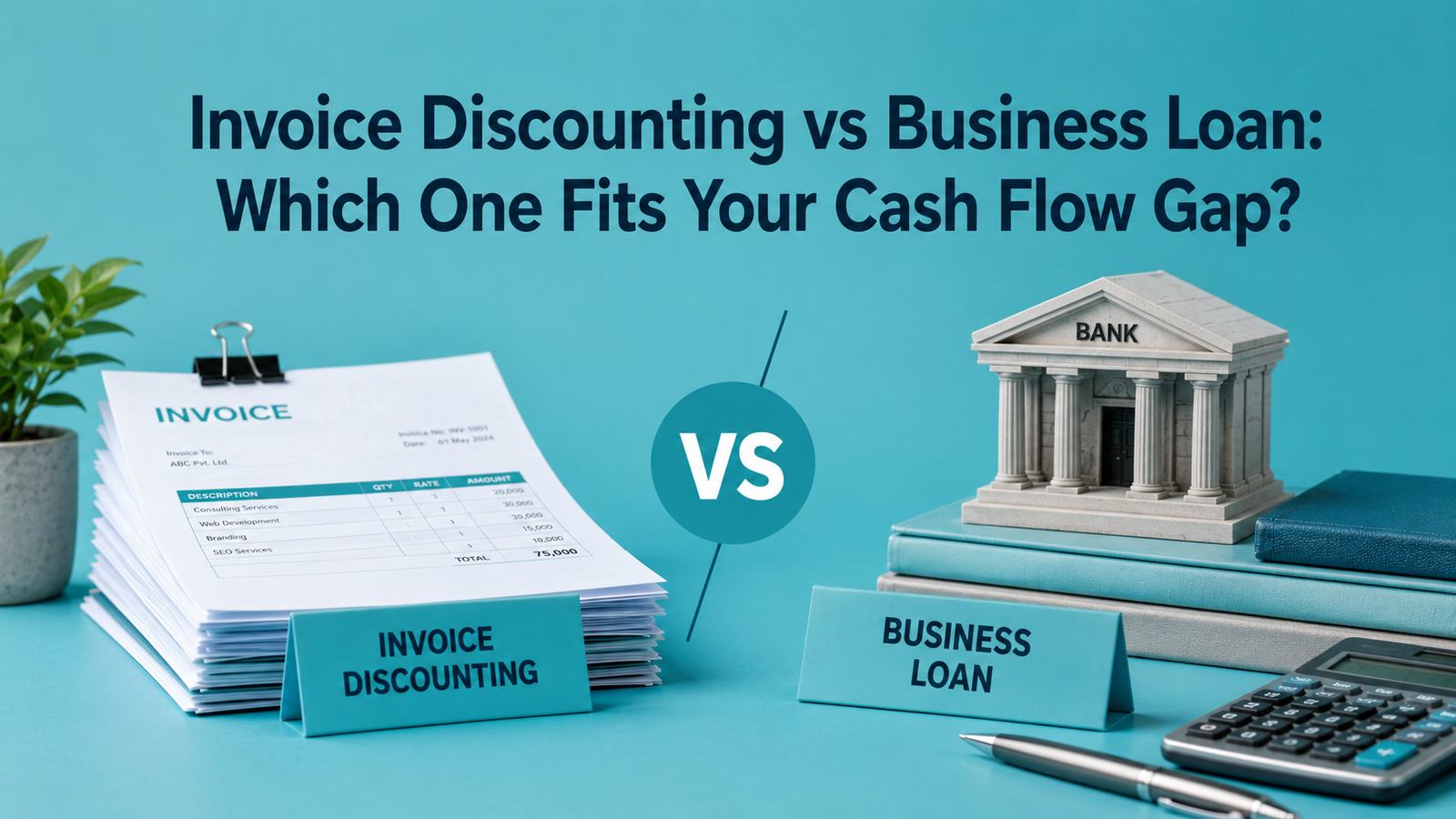
Your orders are healthy. So why is the bank balance always tight?
Most growing businesses in India do not fail for lack of orders. They struggle because the money they have already earned is stuck somewhere between an approved invoice and an actual bank credit.
A supplier delivers goods to a large buyer, raises a bill, and then waits. Thirty days. Sixty days. Sometimes ninety. Meanwhile, salaries are due, GST has to be paid, and the next raw material order cannot be delayed. The revenue is real, but it is sitting in someone else’s books.
This is the cash flow gap, and it has become one of the defining problems for Indian MSMEs. By one estimate, close to ₹7.34 lakh crore of MSME money was locked in delayed receivables as of March 2024, and more than 80% of small businesses say payment delays interfere with their cash cycle. When that gap widens, most promoters weigh two familiar options: invoice discounting or a business loan.
Both put money in your account, but they solve very different problems, and choosing the wrong one can cost you more than the gap itself. This guide focuses on invoice discounting: what it is, when it fits, and how it compares to a term loan.
Invoice discounting is a simple idea: you borrow against money your customers already owe you, instead of borrowing against your future.
Here is how it works. You raise an invoice on a creditworthy buyer, submit it to a financier, and receive a large share of its value upfront, usually between 70% and 90%. Your business gets cash within a day or two. When the buyer pays on the due date, you settle the advance along with a small fee and keep the balance.
The invoice itself acts as the security, and that single feature changes everything about how the product behaves.
Key features and benefits:
- You do not pledge property or machinery. The receivable is the collateral, so hard assets stay free for other uses.
- Money moves fast. Because the financier is lending against a bill you already hold, funds often arrive within 48 hours rather than the weeks a fresh loan takes.
- It does not sit on your balance sheet as long-term debt. You are converting an asset (a receivable) into cash, not stacking up a multi-year liability.
- It scales with your sales. The more you invoice reputable buyers, the more working capital you can unlock. Financing grows as your business grows.
- Pricing is often competitive. On regulated platforms, invoice discounting typically costs in the region of 1% to 1.5% of the invoice value per month, and rates improve when your buyer has a strong credit profile.
In short, invoice discounting turns slow-moving receivables into usable working capital without making you wait out the full credit period.
How it differs from a business loan
A business loan is the more familiar route. You apply, the lender studies your financials and repayment ability, and a sanctioned amount is disbursed as a lump sum. You then repay it in fixed EMIs over a set tenure, often three to seven years.
A loan suits needs that are larger and longer term, such as buying machinery, funding a new plant, expanding capacity, or consolidating existing debt. These are better served by a term loan than by discounting one invoice at a time.
The trade-off is commitment. The EMI is due every month, whether or not your customers have paid you. If your revenue is seasonal or lumpy, that fixed outflow can squeeze you in a slow quarter. Invoice discounting flexes with your billing; a loan does not.
The two are not rivals. Many businesses use both a term loan to fund the asset, while an invoice discounting line keeps day-to-day operations liquid. They simply cover different parts of the same cash cycle.
Invoice discounting is not for everyone, and that is exactly why it works so well for the right profile.
It fits best when:
- You sell on credit to large, reputable buyers — corporates, PSUs, government departments, or established mid-market companies that pay reliably but slowly.
- Your cash is stuck in receivables, not in a genuine shortfall. The business is profitable; the money is simply in transit.
- You need liquidity quickly and cannot wait out a long loan sanction process.
- You want to avoid pledging assets or adding long-term debt to your books.
It is a natural fit for manufacturing, auto components, textiles, engineering and capital goods, FMCG distribution, IT and staffing services, pharma, and logistics — essentially any B2B business that invoices strong buyers on credit terms.
On business size, it works across the spectrum. Even a young company with a 10 to 12-month track record can qualify, because the lender underwrites the buyer’s ability to pay as much as your own history. That is a lower bar than most term loans, which require two or more years of operations.
What problems does invoice discounting solve?
The value of the product becomes clear when you look at the day-to-day pressures it relieves.
Bridging the receivables gap. This is the core use. A textile exporter bills a large retailer on 75-day terms but needs to pay weavers next week. Discounting that invoice releases most of its value immediately, so production never stalls.
Meeting fixed obligations on time. Salaries, GST, EPF, and rent do not wait for your buyer’s payment cycle. A steady discounting line smooths these outflows even when receipts are irregular.
Funding the next order. An auto-component supplier lands a bigger contract but cannot buy raw materials until the last invoice is paid. Discounting frees that trapped cash so the business can say yes to growth instead of turning it away.
Managing seasonal or lumpy revenue. For businesses where sales spike around festivals or harvest cycles, discounting provides liquidity in the lean months without the burden of a fixed EMI.
Avoiding expensive short-term borrowing. Instead of dipping into a costly overdraft or unsecured loan to cover a temporary gap, a business can unlock its own earned money at a lower effective cost.
The common thread is timing. Invoice discounting does not add to what you owe over the long run; it pulls forward money you have already earned.
Choosing between discounting, a loan, or a combination is rarely obvious from the outside. The right structure depends on your numbers, your sector, and your cash cycle — not on a generic rule of thumb.
This is where a specialist adds value. At Leverest, the starting point is your situation rather than a product to sell. We study your cash cycle, ticket size, buyer profile, and financials, then help you decide whether invoice discounting, a term loan, or a mix of both actually fits.
Because we work across banks, NBFCs, and AIFs along with structured debt solutions, we can match you with lenders suited to your profile rather than whoever we happen to represent. That matching also improves pricing; you are far less likely to leave money on the table when several financiers evaluate the same mandate.
With more than ₹3,000 crore in executed mandates across sectors, the team has a practical view of which structure works in which situation, and every mandate gets partner-led attention rather than a junior handoff.
Market insights: why demand is rising
Invoice discounting is no longer a niche product. Its growth tracks a structural shift in how Indian businesses fund themselves.
The backdrop is a stubborn financing shortfall. India’s MSME credit gap is estimated at around ₹25 lakh crore, and only about a fifth of small businesses have access to formal credit. When traditional loans are hard to get, unlocking money you have already earned becomes a more practical route.
Regulators have leaned in. The RBI-backed Trade Receivables Discounting System (TReDS), a digital marketplace where MSMEs auction approved invoices to multiple financiers, has scaled sharply. TReDS platforms collectively financed over ₹1.38 lakh crore through around 41.6 lakh invoices in FY24, an 80% jump over the previous year, and cumulative discounting has crossed ₹1.9 lakh crore. More than 80,000 MSMEs are now registered.
Policy is widening the funnel further. From 31 March 2025, all companies with a turnover above ₹250 crore must register on TReDS, pulling more large buyers into the system and giving their suppliers a faster path to cash. That expanding buyer base is a key reason demand keeps climbing.
The pressure it relieves is very real. Official data shows tens of thousands of crores tied up in delayed payment disputes despite the MSMED Act’s 45-day payment rule, a reminder that the underlying problem invoice discounting solves is not going away.
Used well, invoice discounting is powerful. A few avoidable errors trip up first-time users.
Treating it as a rescue for a genuine shortfall. Discounting fixes a timing problem, not a profitability problem. If the business is loss-making, pulling receivables forward only delays the reckoning. Diagnose the gap honestly first.
Ignoring the buyer’s credit quality. The whole product rests on your buyer paying on time. Discounting invoices on weak or slow-paying customers invites disputes and higher costs. Concentrate on your strongest buyers.
Comparing the wrong numbers. A monthly discounting fee and an annual loan rate are not the same thing. Convert everything to a comparable annualised cost before deciding, and factor in speed and flexibility, not just the headline rate.
Using it for the wrong purpose. Funding a five-year machinery purchase by rolling short-term invoices is a mismatch. Long-term assets call for a term loan; recurring receivables gaps call for discounting.
Going it alone with one lender. Accepting the first quote often means overpaying. Comparing offers across banks, NBFCs, and platforms — or having a specialist do it — usually improves both pricing and terms.
Frequently asked questions
Is invoice discounting a loan? Not in the traditional sense. You are advancing money against a specific unpaid invoice rather than borrowing a lump sum against your general creditworthiness. The receivable is the security.
How much of the invoice value can I get upfront? Typically 70% to 90%, depending on the buyer’s profile and the invoice terms. The balance, minus the fee, is released once the buyer pays.
How fast is the money? Often, within 48 hours of the invoice being accepted, because the financier is lending against a bill you already hold.
Do I need to pledge collateral? Usually not. The invoice itself acts as security, which is why hard assets like property or machinery generally stay free.
What does invoice discounting cost? On regulated platforms, roughly 1% to 1.5% of the invoice value per month is common, though pricing depends heavily on your buyer’s credit strength and tenure.
Can a new business use it? Yes. A 10 to 12-month track record is often enough, because lenders weigh the buyer’s ability to pay alongside your own history.
What happens if my buyer does not pay? This depends on the structure — with recourse (you cover the shortfall) or without recourse (the financier bears the risk). Clarifying this before signing is essential.
Can I use both invoice discounting and a business loan? Absolutely, and many businesses do. A loan funds long-term assets while a discounting line keeps working capital flowing.
The bottom line
Invoice discounting and a business loan both bring cash in, but they answer different questions. If your gap is short-term and tied to unpaid invoices, discounting is usually the faster, lighter, more flexible fix — no fresh collateral, no long-term EMI, and money in days rather than weeks. If your need is larger and longer-term, a loan makes more sense. Often, the smartest answer is a considered mix of both.
The right structure comes down to your numbers, not a generic rule. If you are weighing how to fund the coming quarter, it is worth mapping your cash cycle before you sign anything. The team at Leverest can help you evaluate your funding requirement and match it to the structure — and the lenders — that actually fit.