
Somewhere in India this week, a profitable company will walk out of a bank believing it was rejected because the business was not good enough.
In reality, the bank simply could not understand it.
That decision, not the numbers, is what sinks the file.
We see this constantly. A company with real revenue, real customers, and defensible unit economics gets declined. The founder walks out assuming the business was not strong enough.
Usually it was. What was missing was a shared language.
Banks aren’t closed. They’re pattern-matched
Indian banking has built genuine depth in certain industries.
Put a steel plant, an auto-components manufacturer or a road project in front of a seasoned credit officer and he already has a map. He has lent to a hundred of them.
He knows where the cash comes from, which line item tends to break first, what the working capital cycle looks like in a bad year, and what protects him when things go wrong.
That map took decades to draw. It was drawn through cycles, through defaults, through recoveries. It is hard-won and it is valuable.
Now put a business model in front of him that did not exist ten years ago.
Same discipline in the founder. Same rigour in the numbers. But no map. Nothing in his experience to compare it against.
So he does what any careful lender does with something he cannot place. He calls it risk.
This is the part worth sitting with, because it changes what you do about it.
He is not saying your business is weak. He is saying he cannot yet see how it works.
And in credit, unfamiliarity gets priced exactly like risk, even when it is not risk at all.
What a bank is actually reading
Banks do not lend on stories. They lend on:
- DSCR
- Cash flow visibility
- Working capital cycle
- Collateral
- Debt service capacity
Every one of those is a measurement, not an opinion. If your business does not present itself in those five terms, someone has to convert it. If you do not do that work, the credit officer does it for you, using his own assumptions.

There is a difference between:
- A business that cannot service debt.
- A business that can service debt, but has not made that visible to a lender.
The first is a credit problem. Nothing fixes it except better fundamentals.
The second is a translation problem. It is entirely fixable, usually without changing a single thing about how the business operates.
Most of the declines we encounter with new-age companies sit in the second category. The cash flow was there. It was described in language built for an equity audience, to a person underwriting downside.
One example explains the whole problem
Take a SaaS company with predictable subscription revenue.
To the founder, that is recurring income. Contracted, renewing, visible twelve months out.
To a credit officer who has never underwritten SaaS, it is revenue with no asset cover, no security to fall back on, and customers who can leave at thirty days’ notice.
Same numbers. Same company. Two readings that lead to opposite decisions.
Nothing about the business needs to change. What needs to change is which of those two readings reaches the credit committee.
The translation chain
Every credit decision travels the same path:
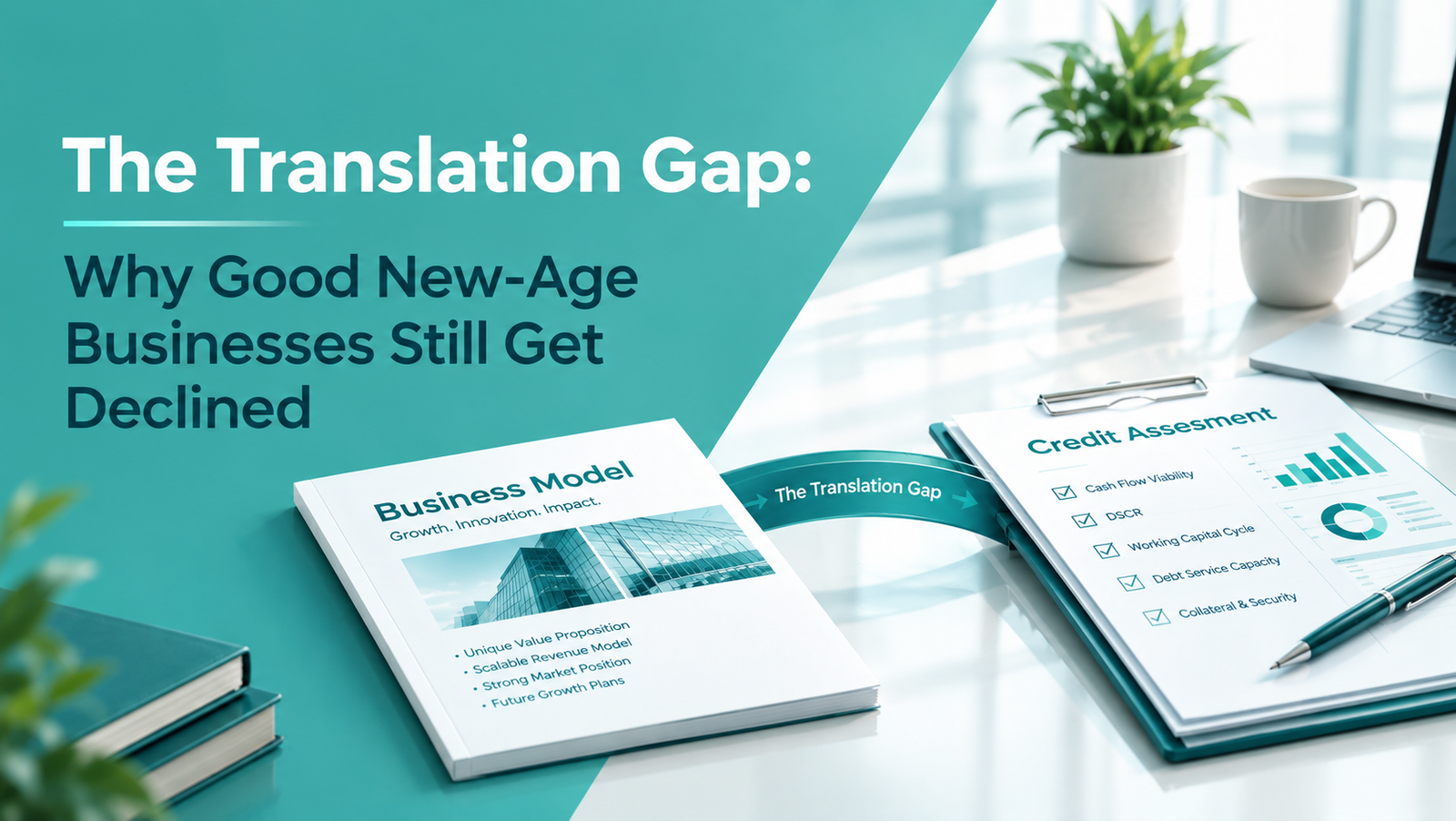
Founder’s language → Business model → Cash flow → Credit metrics → Banker’s decision
Most declines happen at the first link. The business model is sound and the cash flow is real, but the founder’s language never converted into anything the credit metrics could hold. Nothing downstream recovers from that.
What translation actually involves
Standing between a borrower and a lender is not advocacy. It is not making the business sound better than it is. Any experienced credit officer detects that instantly, and once he does, everything else you say is discounted.
The work is narrower and more technical than that. Four things have to become legible.
Where the cash actually comes from. Not revenue. Cash. Who pays, on what cycle, with what reliability, and what happens to that cycle under stress? A credit team relaxes when it can see money arriving on a rhythm it can model.
What is the business model underneath the category? Strip out the sector vocabulary and describe the economic engine in plain terms. Very often, a new-age business behaves, financially, like something the bank already lends to. A subscription business with predictable renewals has more in common with an annuity than with a technology company. Say so.
What are the real risks? Stated plainly, by you, before the credit team finds them. Every risk you leave unmentioned becomes their discovery rather than your disclosure.
What already contains those risks? A risk named without a mitigant is just a reason to decline. Named with the structure that covers it, it becomes a term, and terms are negotiable.
Do these four properly and the room changes. The banker stops looking at an exception and starts looking at a structure
he recognises. From there, it becomes an ordinary credit conversation about pricing, security, and tenor.
Before your next lender meeting
Four questions to answer for yourself first:
- Can I explain where the cash comes from, not just where the revenue comes from?
- Can I describe my business model in language the credit team already lends against?
- Have I named the real risks myself, before they are found?
- Have I shown the structure that contains each of those risks?
Four clear answers and you are having a credit conversation. Anything less and you are having a comprehension conversation, and those tend to be decided before you leave the room.

The translation runs in both directions, and the second direction gets ignored.
Founders routinely misread what a lender is even asking. They hear caution as hostility, or read a request for security as a lack of belief in the business. It isn’t. A lender’s entire job is to model the downside. He is not buying your ceiling. He is underwriting your floor.
A founder who understands that stops arguing for his growth story in credit meetings and starts answering the question actually being asked. That shift alone changes outcomes.
So part of our work faces the other way: making the lender’s logic legible to the borrower, so the founder can meet it properly instead of resenting it.
What this means if you’re raising
If you are running a business that is newer than the average credit policy, assume the burden of comprehension sits with you.
It shouldn’t have to, but commercially, it does. Waiting for the banking system to catch up to your model is not a funding strategy.
Practically, that means going into a credit conversation with your cash mechanics explained before you are asked, your risks named before they are found, and your model anchored to something the credit team already underwrites.
And it means recognizing when the gap is too wide to close from your side of the table alone.
The gap is closable
The businesses that get funded first are rarely the strongest ones. They are the ones that were made legible to the person deciding.
That gap between funded and declined is often not financial strength at all. It is whether anyone took the trouble to stand between two languages and translate.
Leverest Financial Services advises promoters, founders, and CFOs on debt structuring, lender selection, and credit architecture across PSU banks, private banks, NBFCs, and AIFs. If your business model is newer than the credit policy it’s being judged against, that’s a conversation worth having.