
Why Your Loan Application Gets Rejected And What to Fix Before You Apply Again

Every year, thousands of Indian SMEs and mid-cap businesses walk into banks with genuine funding needs and walk out empty-handed.
The rejection letter rarely explains much. The loan officer offers little clarity.
This lack of answers leaves the promoter wondering whether the problem was the business, the paperwork, or something else entirely.
The frustrating truth is that most loan rejections are not about the underlying business; they are about how the applicant presented that business.
The Bank Is Not Your Partner — It Is an Underwriter
The single biggest mindset error promoters make is treating a bank relationship like a friendship.
Banks do not fund businesses out of loyalty or potential.
They fund proposals that demonstrate repayment capacity with documented evidence.
Your decades of experience, your reputation in the market, and your verbal track record none of these appear in the credit note that goes to the sanctioning committee.
What appears there is your financials, your project report, your collateral structure, and your DSCR.
If any one of these tells a story the underwriter cannot defend to his committee, the file comes back rejected.
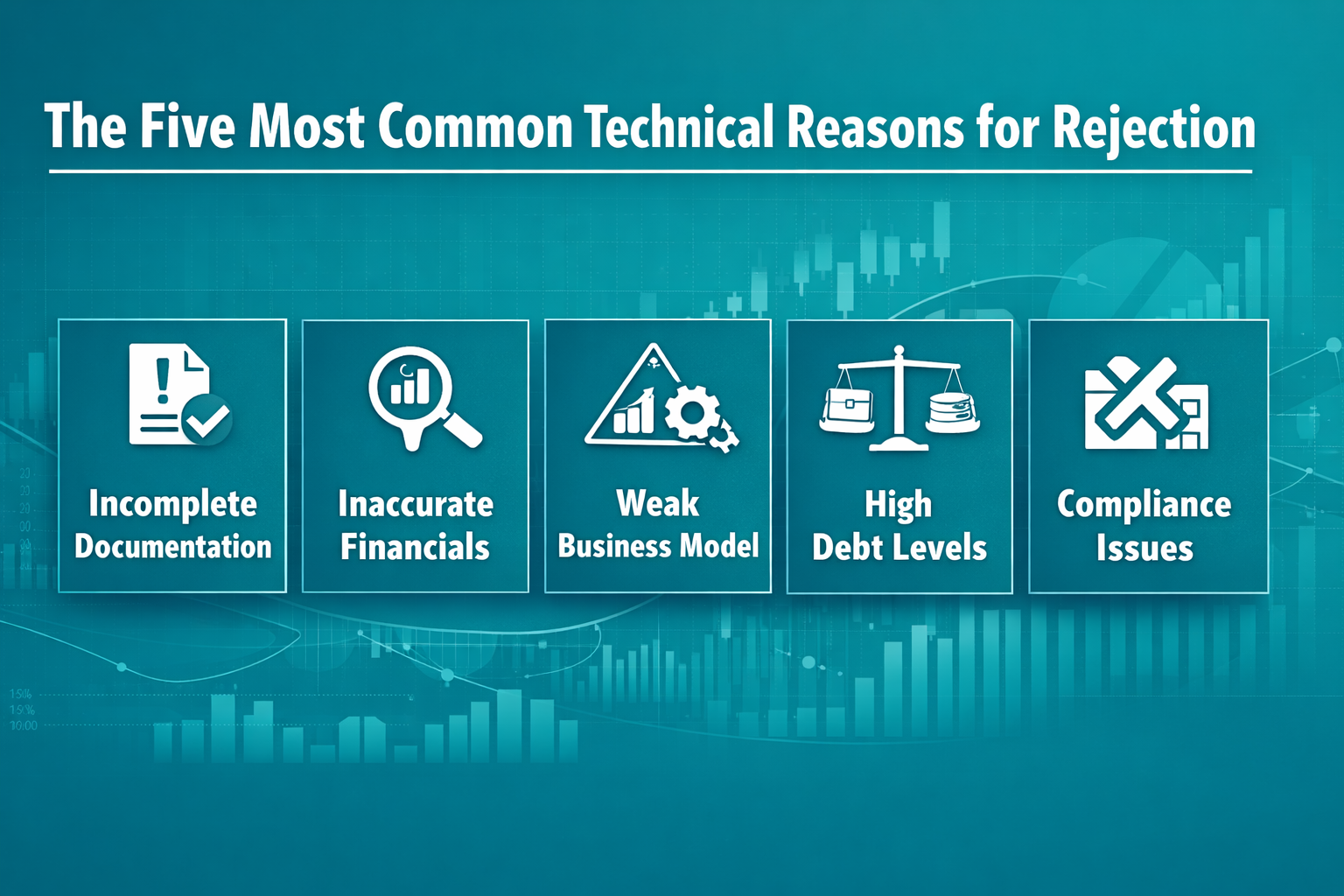
The Five Most Common Technical Reasons for Rejection
Most loan rejections trace back to a predictable set of technical deficiencies. First, insufficient DSCR — the Debt Service Coverage Ratio must typically be above 1.25x to 1.5x, depending on the lender, and a project report that does not model this clearly is a red flag.
Second, over-leveraging — if you have already stretched your debt-to-equity ratio, lenders see a new loan as compounding risk, not solving it.
Third, inadequate collateral coverage — many promoters assume their primary security is enough; lenders often want collateral coverage of 1.33x to 1.5x.
Fourth, incomplete documentation — missing ITRs, unaudited financials, unsigned balance sheets, or gaps in KYC instantly signal unpreparedness. Fifth, the wrong lender — a steel plant asking a housing finance company for project finance, or an MSME asking a large PSU bank for an unsecured working capital loan, is a mismatch that no presentation can fix.
What “Bankable” Really Means
The word “bankable” gets used loosely, but it has a precise meaning in credit circles. A bankable proposal tells a coherent story through numbers, offers defensible assumptions, acknowledges and mitigates risks, and clearly establishes the promoter’s contribution.
It means the credit officer reading your file can build a case for sanction without having to fill in the gaps himself.
If he has to guess your depreciation assumptions, ask twice for your projected revenue basis, or question whether your land is registered or agricultural — your file is not bankable yet.

The Role of Lender Selection
One of the most underappreciated variables in loan approval is simply choosing the right lender for your ticket size, sector, and structure.
Public sector banks are strong for large project finance with government backing. Private banks are faster for working capital and mid-market term loans.
NBFCs are more flexible on collateral and promoter profile. AIFs work for growth-stage or acquisition funding.
Applying to the wrong lender is not a minor inefficiency — it is a rejection waiting to happen, and it also leaves a footprint in your CIBIL records that makes the next application harder.
What to Do Before You Apply Again
Before reapplying after a rejection, three things must happen.
One: get a clear, honest diagnostic of exactly why the previous application failed — not the official reason, but the actual underwriting objection.
Two: fix the structural issue, whether that means improving your DSCR by renegotiating existing loan tenures, clearing a small NPA, or building six more months of audited financials.
Three: prepare a proper credit memorandum — a document that pre-emptively answers every question a credit committee will ask. Promoters who do this work before approaching a lender consistently see better outcomes.
Conclusion
A loan rejection is not a verdict on your business. It is feedback on your presentation.
The businesses that secure funding are rarely the strongest in the room; they are the ones that walk in most prepared.
If you have faced a rejection or are planning a fresh application
the most valuable investment you can make is getting an expert credit review before you approach any lender.
The cost of that review is a fraction of the cost of another rejection.