
Two businesses can post the same Rs 20 crore turnover and still need completely different working capital limits. Why? Because turnover alone doesn’t determine funding need, the operating cycle does.
A textile trader in Kolkata and an auto component manufacturer in Howrah make the point concrete. The trader collects cash within a month of selling. The manufacturer waits four months for an OEM to clear an invoice. If both are assessed on the same yardstick, one of them ends up under-funded or over-funded.
Indian banks use three main methods to size a working capital limit: the turnover method, MPBF, and the cash budget method. Each one asks a different question about the same business, and the choice of method usually matters more to the outcome than anything in the loan application itself.
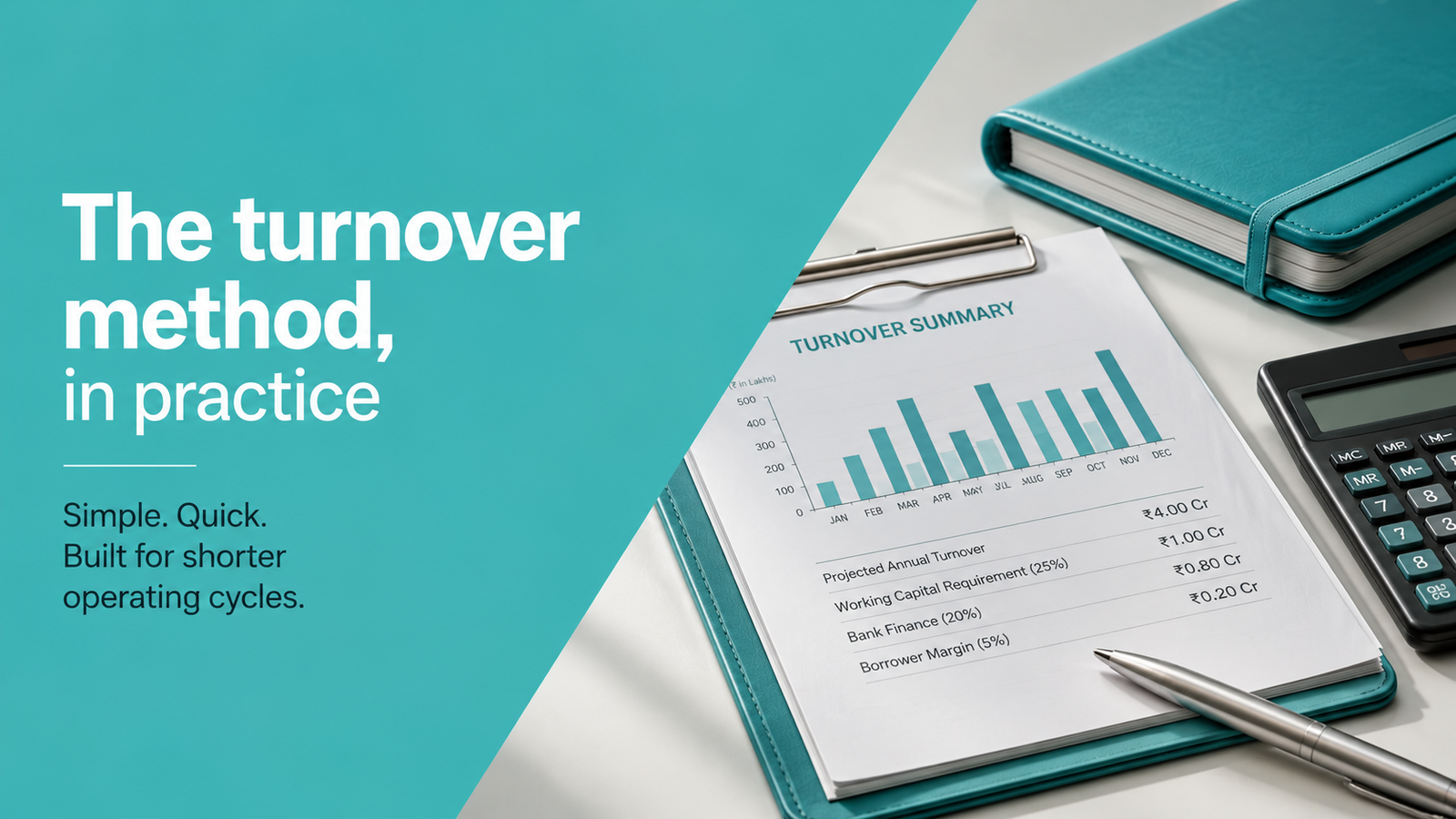
The turnover method comes from the Nayak Committee norms of 1992, built for small borrowers who could not produce detailed balance sheet projections. Working capital is taken at 25% of projected annual turnover. The borrower puts in 5% of turnover as margin. The bank finances the remaining 20%.
Case: Suresh Textiles
Suresh Textiles is a cloth wholesaler in Barabazar. It buys fabric on 30-day credit from mills, sells to retailers on 45-day credit, and holds about three weeks of stock. Its projected turnover for the year is Rs 4 crore.
- Working capital requirement: 25% of Rs 4 crore = Rs 1 crore
- Borrower margin: 5% of Rs 4 crore = Rs 20 lakh
- Bank finance: 20% of Rs 4 crore = Rs 80 lakh
The assessment may be completed without a detailed projected balance sheet or full CMA exercise, depending on the lender’s requirements. The bank typically asks for GST returns, the last two years of financial statements, and a stock statement, and the assessment can usually be closed in a single visit.
This works because Suresh’s operating cycle, roughly two and a half months, sits close to what the 25% figure already assumes. If the cycle ran to five or six months, the same formula would leave the business short.
Many banks use the turnover method for smaller working-capital exposures, with the applicable threshold varying by lender and borrower profile. Beyond that threshold, or where the operating cycle runs past three months, banks generally move to MPBF.
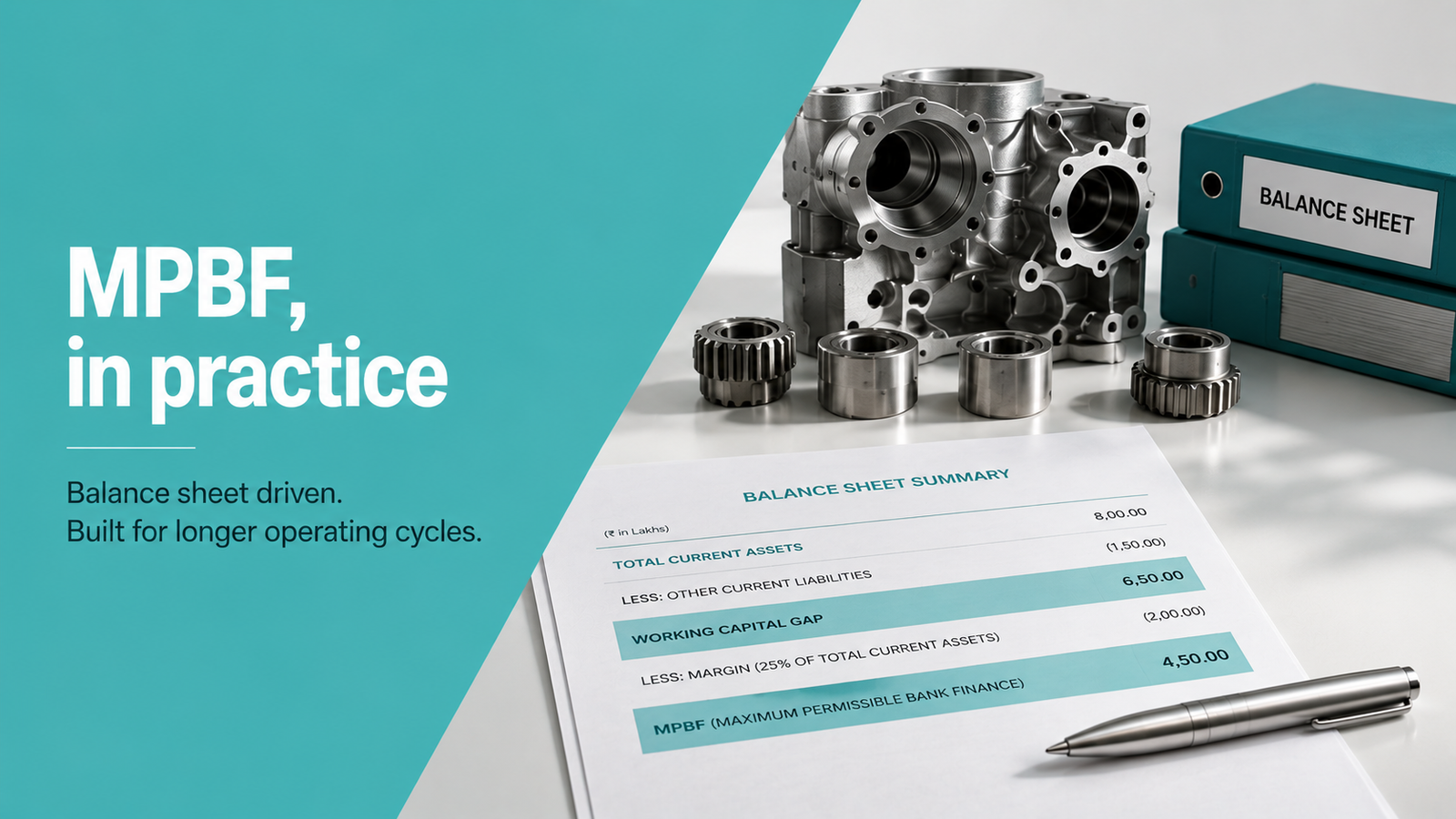
MPBF stands for Maximum Permissible Bank Finance. Where the turnover method assumes a cycle, MPBF is read directly off the balance sheet. Where banks continue to use a Tandon-based approach, Method II is commonly used as a framework: the bank works out the working capital gap (total current assets less other current liabilities), then deducts a margin of 25% of total current assets to arrive at MPBF.
Case: Bengal Precision Castings
Bengal Precision Castings supplies machined components to two auto OEMs from a plant in Howrah. Projected turnover for the year is Rs 18 crore, well above the level where banks apply the turnover method. Its cycle runs closer to four months: it imports part of its raw material, holds finished stock against OEM call-off schedules, and waits 90 to 120 days for payment after invoicing.
- Total current assets (stock, receivables, other current assets): Rs 8 crore
- Other current liabilities (trade creditors, provisions, statutory dues): Rs 1.5 crore
- Working capital gap: Rs 8 crore less Rs 1.5 crore = Rs 6.5 crore
- Margin (25% of total current assets): Rs 2 crore
- MPBF: Rs 6.5 crore less Rs 2 crore = Rs 4.5 crore
Under the turnover method, 20% of Rs 18 crore would give Rs 3.6 crore, about Rs 90 lakh short of what the balance sheet shows the business actually needs. The flat 25% assumption behind the turnover method reflects a shorter cycle than Bengal Precision Castings runs.
The bank does not take these figures at face value. It checks inventory ageing, whether receivables past 120 days are genuinely collectable, and whether the projected turnover is consistent with last year’s sales and the current order book. A large gap between last year’s actuals and this year’s projection is usually the first thing a credit officer questions.
The RBI withdrew the mandatory MPBF prescription, along with the associated 1.33:1 minimum current ratio, in April 1997. Bank boards now set their own methods. In practice, most mid-sized and larger borrowers are still assessed on a version of Tandon’s Method II, because it remains the most direct way to connect a credit limit to the balance sheet. Some banks call it Assessed Bank Finance rather than MPBF, but the calculation is largely the same.
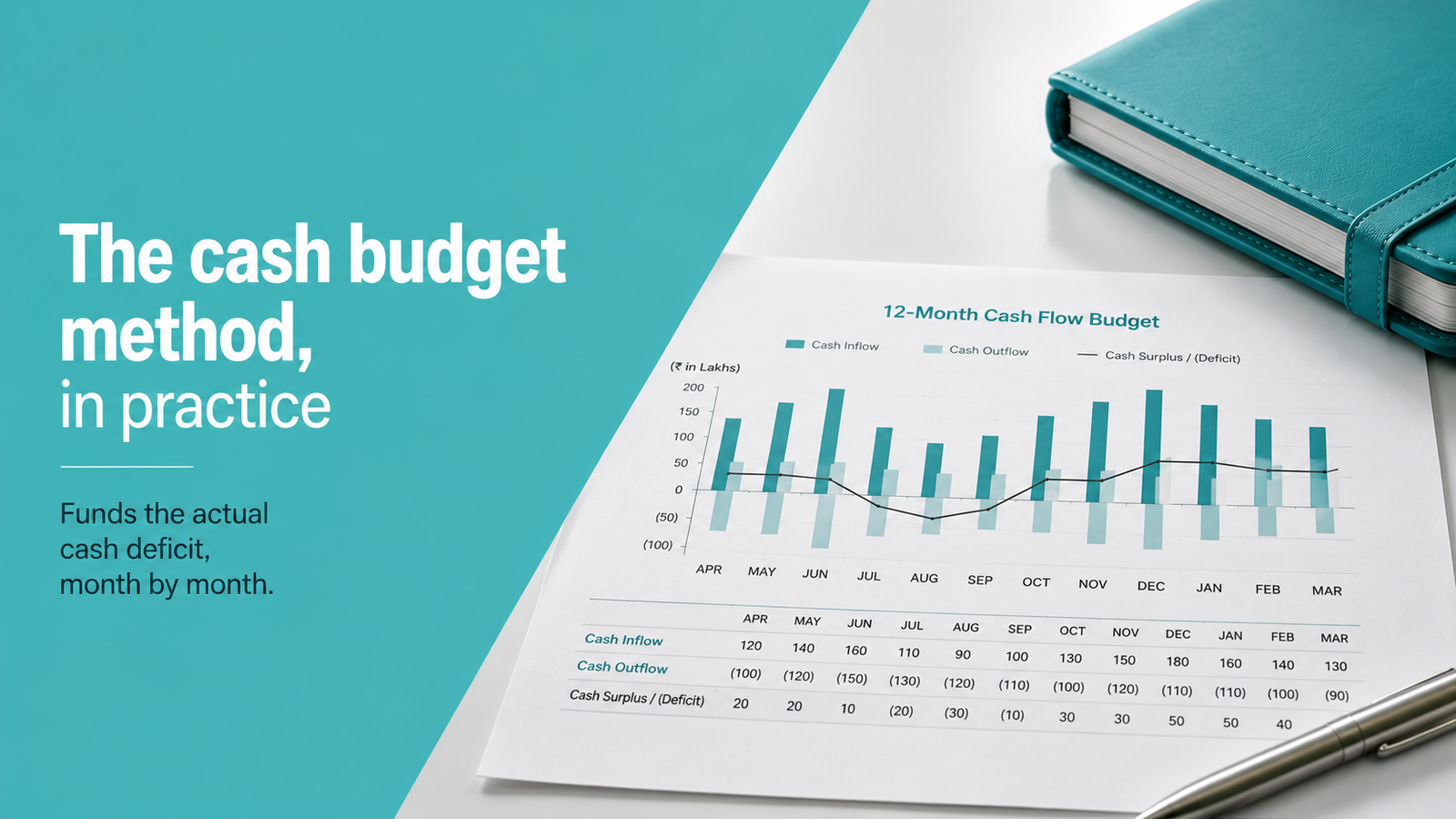
Neither of the methods above works well for a business whose cash need moves sharply through the year. The cash budget method funds the deficit itself, not an average spread over twelve months.
Case: Uttarpara Construction & Infra
Uttarpara Construction is executing a 14-month road contract for a state PWD. Material procurement- bitumen, aggregate, and steel- is front-loaded in the first half of the project. At the same time, milestone payments from the PWD arrive only after each stretch of road is measured and certified, roughly every two months. A simplified six-month extract of the projected cash budget:
Closing cash position
Hover or tap a point for that month’s procurement context. Values are in Rs lakh; figures in brackets denote a deficit.
| Month | Opening | Inflows | Outflows | Closing |
|---|
The deepest point falls in Month 3, a deficit of Rs 1.8 crore. That figure, not an average monthly figure and not a percentage of the annual contract value, is what the bank sizes the limit against.
Had Uttarpara instead been assessed on turnover, using the annual contract value as a proxy, a flat 20% would either sit idle in months with no procurement or leave the business Rs 60 to 70 lakh short in Month 3, exactly when the steel and bitumen bills fall due.
For this method, the bank asks for a certified project cost estimate, a month-wise procurement plan, and the payment terms in the PWD contract, rather than two years of financial statements. It also reviews the budget against actual progress once work starts, and can revise the limit if the deficit runs deeper than projected.
Working capital assessment
MPBF, turnover, or cash budget: side by side
Method 1
Turnover method
Basis of calculation
25% of projected annual turnover (bank funds 20%, borrower brings 5%)
Typical eligibility
Indicative ceiling near Rs 5 crore in fund based limits (some banks extend this to Rs 7.5 crore for SME borrowers); the exact threshold varies by lender
Borrower margin
5% of projected turnover
What the bank asks for
GST returns, two years of financial statements, a stock statement
Best suited to
Traders, distributors, and service businesses with a two to three month operating cycle
Where it goes wrong
Understates the requirement once the operating cycle runs past three months
Method 2
MPBF
Basis of calculation
Working capital gap (total current assets minus other current liabilities), less a 25% margin on total current assets
Typical eligibility
Generally applied above the turnover-method range, or once the operating cycle runs past about three months; cutoffs vary by lender
Borrower margin
25% of total current assets; historically linked to a current ratio near 1.33:1 under the Tandon framework, though not a universally mandated requirement today
What the bank asks for
CMA report, projected balance sheet and profit and loss, inventory and receivable ageing, stock and book debt statements
Best suited to
Manufacturers, larger distributors, and businesses with import content or extended receivables
Where it goes wrong
Heavier to prepare; projections that do not reconcile with GST turnover or last year’s audited numbers get cut down
Method 3
Cash budget method
Basis of calculation
The single largest cumulative cash deficit across a month-wise projected cash flow
Typical eligibility
No fixed ticket size; applied where the business is seasonal or project driven, regardless of scale
Borrower margin
Set case by case against the depth and length of the projected deficit
What the bank asks for
Month-wise procurement and payment schedule, the underlying contract or purchase order, a project cost estimate
Best suited to
Seasonal processors, contractors, and other project-based businesses
Where it goes wrong
Needs monitoring through the year; a bank can pull the limit back if actual drawdown outruns the projected budget
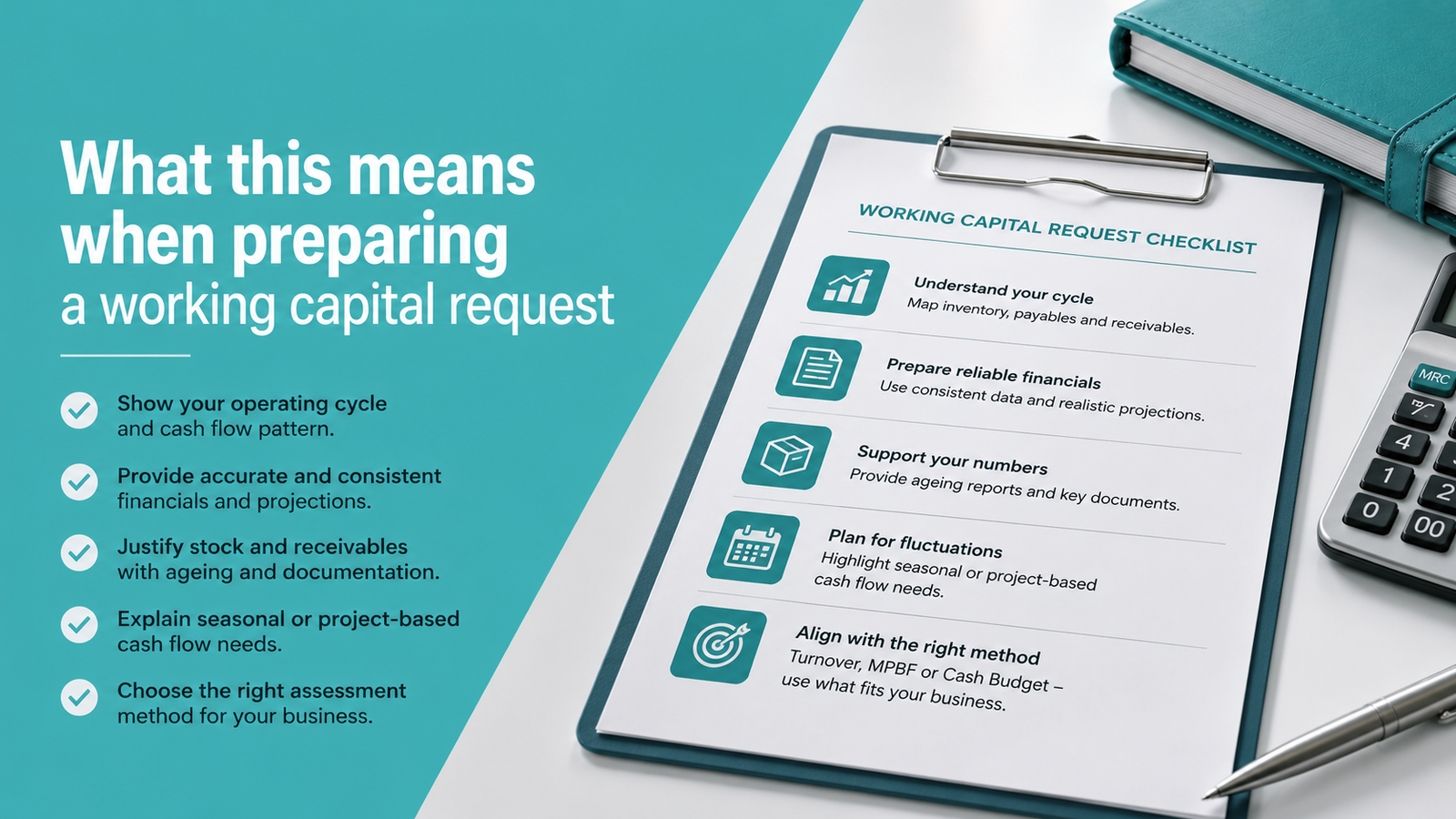
None of this is decided by the borrower. A bank’s credit policy sets which method applies at which ticket size, and a relationship manager rarely renegotiates it on request. What a business, or its advisor, can influence is how well the numbers support the method the bank is likely to apply.
For a business near the turnover method threshold, that means keeping GST filings and financial statements consistent with the turnover being projected. For a business likely to be assessed on MPBF, it means building the CMA report on real inventory and receivable data rather than an aspirational projection, since credit committees compare this year’s numbers against last year’s actuals as a first check.
For a seasonal or project business pushing for cash budget treatment, it means a procurement and payment schedule the bank can verify against the underlying contract, not a spreadsheet built after the fact.
Since the RBI withdrew the mandatory MPBF prescription in 1997, this discretion sits mostly with the bank. Two lenders can size the same borrower differently within their own credit policy, which is one reason mid-market borrowers often approach more than one bank, or work with an advisor who already knows how a particular lender’s credit committee reads a CMA report, before deciding which numbers to present.
The key is not simply calculating the highest possible working-capital limit. It is demonstrating why the proposed limit is justified under the methodology the lender is likely to apply.