
Loan Restructuring in India: Options Before an Account Turns NPA
A loan account rarely fails overnight. It slips. The gap between the first missed payment and the ninety-first day is where loan restructuring in India actually works.
Loan restructuring in India is one of the few options available to a borrower before an account tips into NPA. A loan account rarely fails overnight — it slips. The collection cycle stretches, a project milestone moves, and one interest servicing date becomes difficult. Ninety days later the same account is an NPA, and the options that were available in month one have mostly closed.
That gap between the first missed payment and the ninety-first day is where loan restructuring in India actually works. Most borrowers approach their lender well after it has passed. By then the conversation is no longer about restructuring. It is about recovery.
What Loan Restructuring Means Under RBI Norms
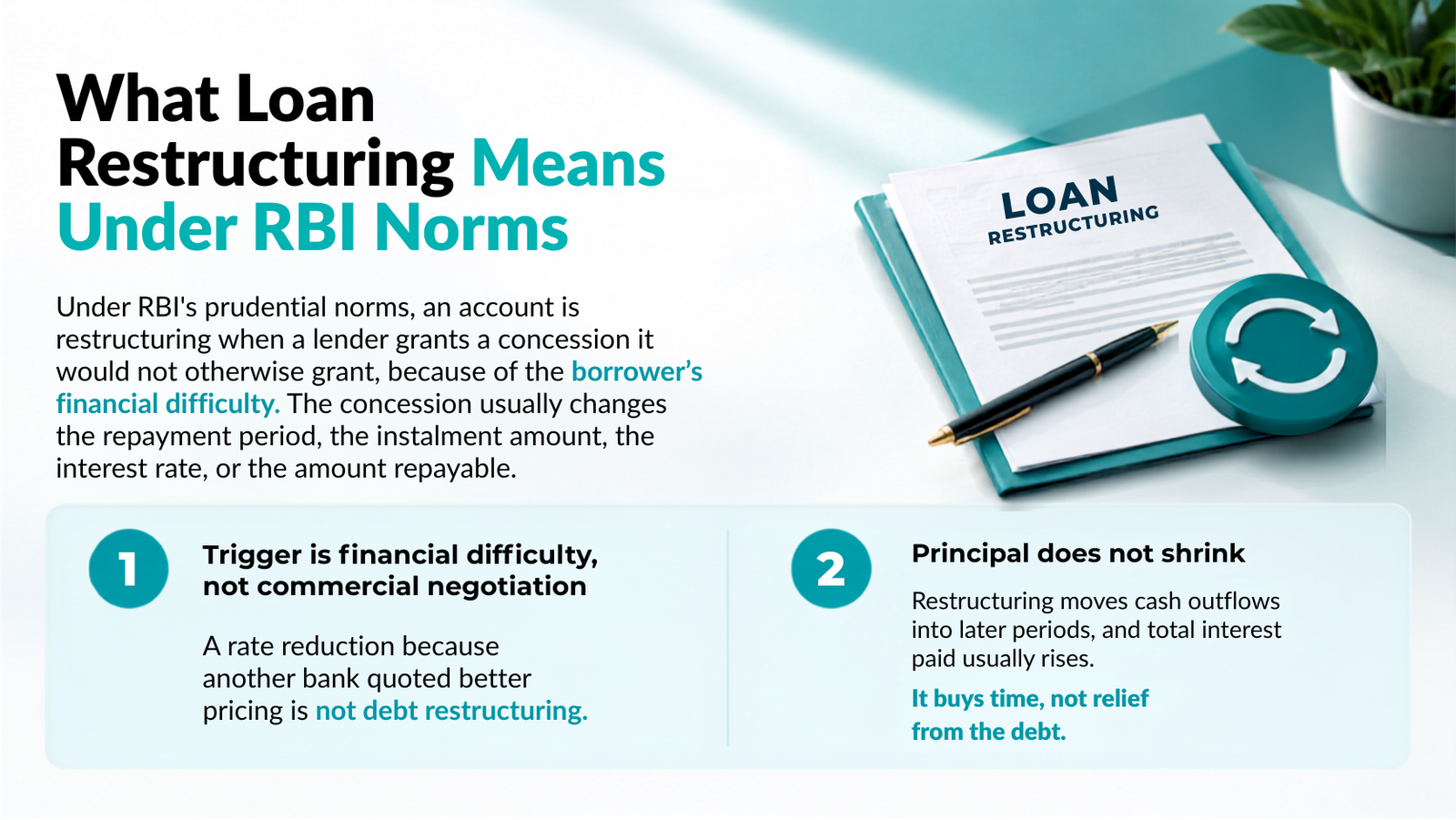
Under RBI’s prudential norms, an account is restructured when a lender grants a concession it would not otherwise grant, because of the borrower’s financial difficulty. Specifically, the concession usually changes the repayment period, the instalment amount, the interest rate, or the amount repayable.
Two things follow from this definition. First, the trigger is financial difficulty, not commercial negotiation — a rate reduction because another bank quoted better pricing is not debt restructuring. Second, the principal does not shrink. Instead, restructuring moves cash outflows into later periods, and total interest paid usually rises. In short, it buys time, not relief from the debt.
The Regulatory Framework for Loan Restructuring in India
A business does not turn into an NPA the way a home loan borrower does. Understanding this framework is therefore central to any loan restructuring in India, because a company usually holds several facilities at once and each type goes bad in its own way. Below is how each slips, in plain terms.
A CC or OD account is not judged on EMI payments. It is judged on whether it stays “in order.” An account is flagged as out of order when any of the following continues for 90 days:
The outstanding balance stays continuously above the sanctioned limit or the drawing power.
No money comes into the account at all for 90 continuous days.
Money comes in, but not enough to cover the interest debited during that 90-day period.
Special Mention Account Steps for CC/OD Accounts
Unlike term loans, CC and OD accounts skip SMA-0. The account moves to SMA-1 between days 31 and 60, then SMA-2 between days 61 and 90.
A project loan is measured against a fixed completion date called the Date of Commencement of Commercial Operations (DCCO), agreed at sanction. The account slips to NPA if:
- Principal or interest remains overdue for 90 days
- The project does not begin operations by the agreed DCCO
- A DCCO extension goes beyond what RBI regulations permit
The same 90-day logic applies here. A discounted bill unpaid beyond 90 days becomes an NPA. Overdue receivables on derivative contracts with positive mark-to-market value, and unpaid liquidity facilities in securitisation transactions, follow the same rule.
Classification happens at the borrower level, not the facility level. If any one facility of a borrower crosses 90 days overdue, every facility that borrower holds with that lender is classified as NPA. To restore all accounts to standard, the borrower must clear arrears across all facilities — not just the one that triggered the default.
The 2019 Stressed Assets Framework
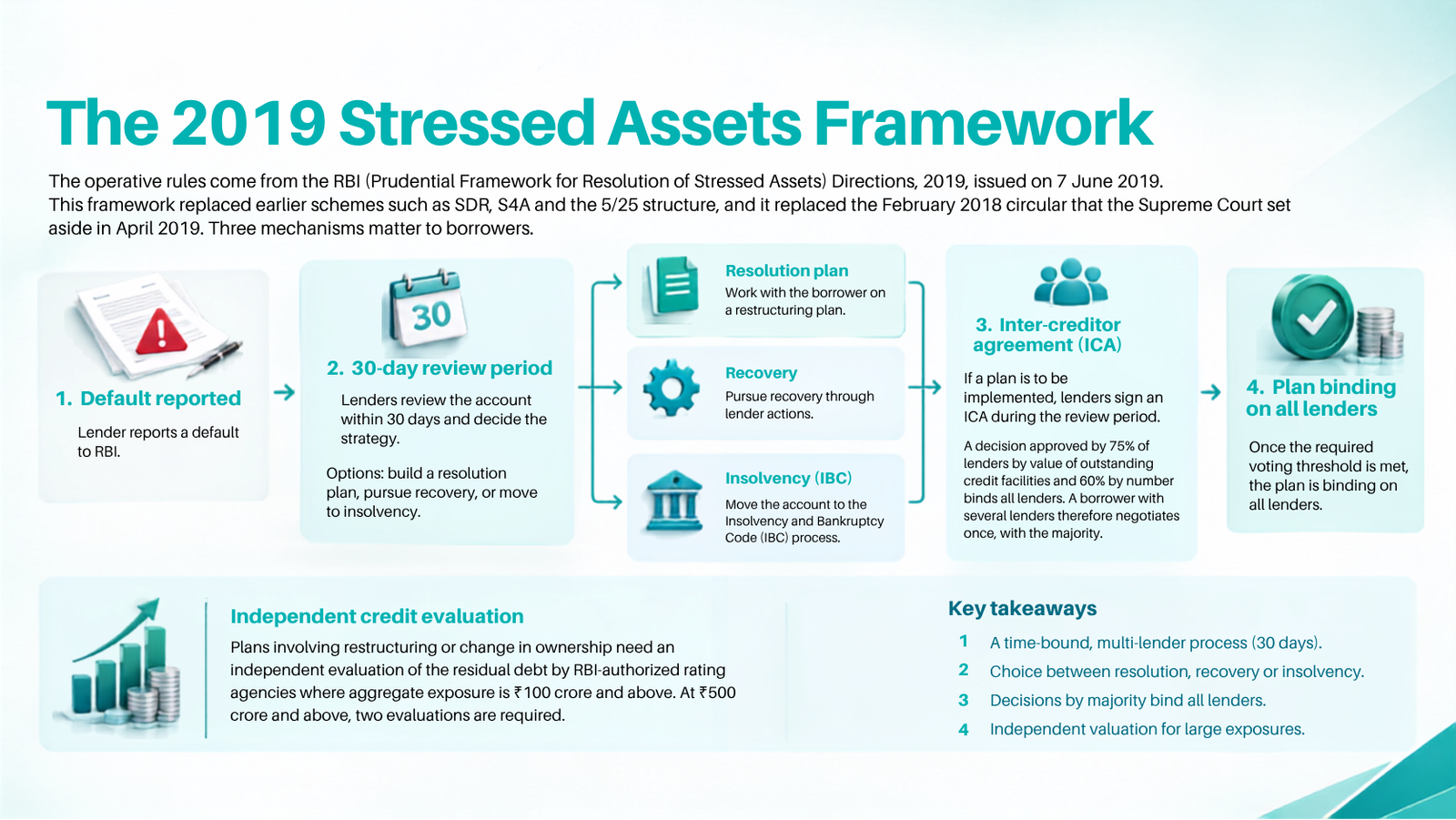
The operative rules come from the RBI (Prudential Framework for Resolution of Stressed Assets) Directions, 2019, issued on 7 June 2019. This framework replaced earlier schemes such as SDR, S4A and the 5/25 structure, and it replaced the February 2018 circular that the Supreme Court set aside in April 2019. Three mechanics matter to borrowers.
The 30-Day Review Period
A 30-day review period. Once a lender reports a default, lenders review the account within 30 days and decide the strategy. At this point, they may build a resolution plan, pursue recovery, or move to insolvency. The choice rests with them.
The Inter-Creditor Agreement
An inter-creditor agreement. Where a plan is to be implemented, lenders sign an ICA during the review period. Consequently, a decision approved by 75 percent of lenders by value of outstanding credit facilities and 60 percent by number binds all of them. As a result, a borrower with several lenders therefore negotiates once, with the majority.
Independent Credit Evaluation
Independent credit evaluation. Furthermore, plans involving restructuring or change in ownership need an independent evaluation of the residual debt by RBI-authorised rating agencies where aggregate exposure is ₹100 crore and above. At ₹500 crore and above, two evaluations are required.
Loan Restructuring Options Available in India
Under RBI norms, a lender can modify the following when restructuring a facility:
- Repayment terms — Extending the tenure, reducing instalment size, or changing the total amount payable.
- Interest rate — Resetting or reducing the rate on the facility.
- Credit lines — Rolling over existing facilities, enhancing limits, or sanctioning additional facilities to give the business enough room to trade out.
- Curing defaults — Releasing additional funds into an account already in default, specifically to help clear arrears and bring it back into order.
- Compromise settlements — Agreeing a settlement amount where the borrower is given more than three months to pay.
Project loans have one relief that other facilities do not. A bank may revise the DCCO without automatically classifying the account as NPA, giving a genuinely delayed project room to finish. This exception has hard limits: the account still slips to NPA if principal or interest is 90 days overdue, if operations do not start by the revised DCCO, or if the extension goes beyond the permissible regulatory period.
Once an account has been classified as NPA through restructuring or a missed DCCO, the standard ‘clear all arrears and return to standard’ rule does not automatically apply. Upgradation of restructured accounts is governed by specific RBI circulars, making the path back slower and more closely supervised than for an ordinary NPA.
What Lenders Assess
In any loan restructuring in India, the application is judged on viability, not hardship. Essentially, the credit committee is answering one question: after the concession, will this borrower generate enough cash to service the revised debt?
Specific Corporate Credit Modifications Evaluated as Restructuring
Every document requested feeds that viability question. Specifically, expect audited financials, current-year provisionals, month-wise cash flow projections through the revised schedule, GST returns, receivables ageing, security valuation, and a dated explanation of what caused the stress. In addition, larger cases usually require a techno-economic viability study. Lenders also expect promoter contribution and generally seek fresh or reaffirmed personal guarantees. Indeed, a promoter seeking relief while declining to bring funds in has effectively answered the viability question already.
- ✓Audited financials
- ✓Current-year provisionals
- ✓Month-wise cash flow projections
- ✓GST returns
- ✓Receivables ageing
- ✓Security valuation
- ✓Cause of stress (dated explanation)
- ✓Techno-economic viability study (larger cases)
- ✓Promoter contribution
- ✓Personal guarantees (fresh or reaffirmed)
Special Assessment: DCCO Revisions for Project Loans
Where a project loan is involved, lenders specifically assess whether the revised DCCO is realistic given construction progress, regulatory approvals, and market conditions. Importantly, the evaluation goes beyond financial statements and includes a physical project status review. Therefore, the revised schedule must show a credible path to commercial operations within the extended regulatory window.
Upgradation Assessment for Restructured Corporate Loans
For accounts already classified as NPA through restructuring, the lender’s credit committee assesses upgradation separately under the applicable RBI circular. As a condition, the borrower must demonstrate sustained performance under the revised repayment structure over the prescribed period before the account can be upgraded. This is consequently a distinct process from standard NPA resolution and is tracked more closely.
Considerations Before Choosing Loan Restructuring in India
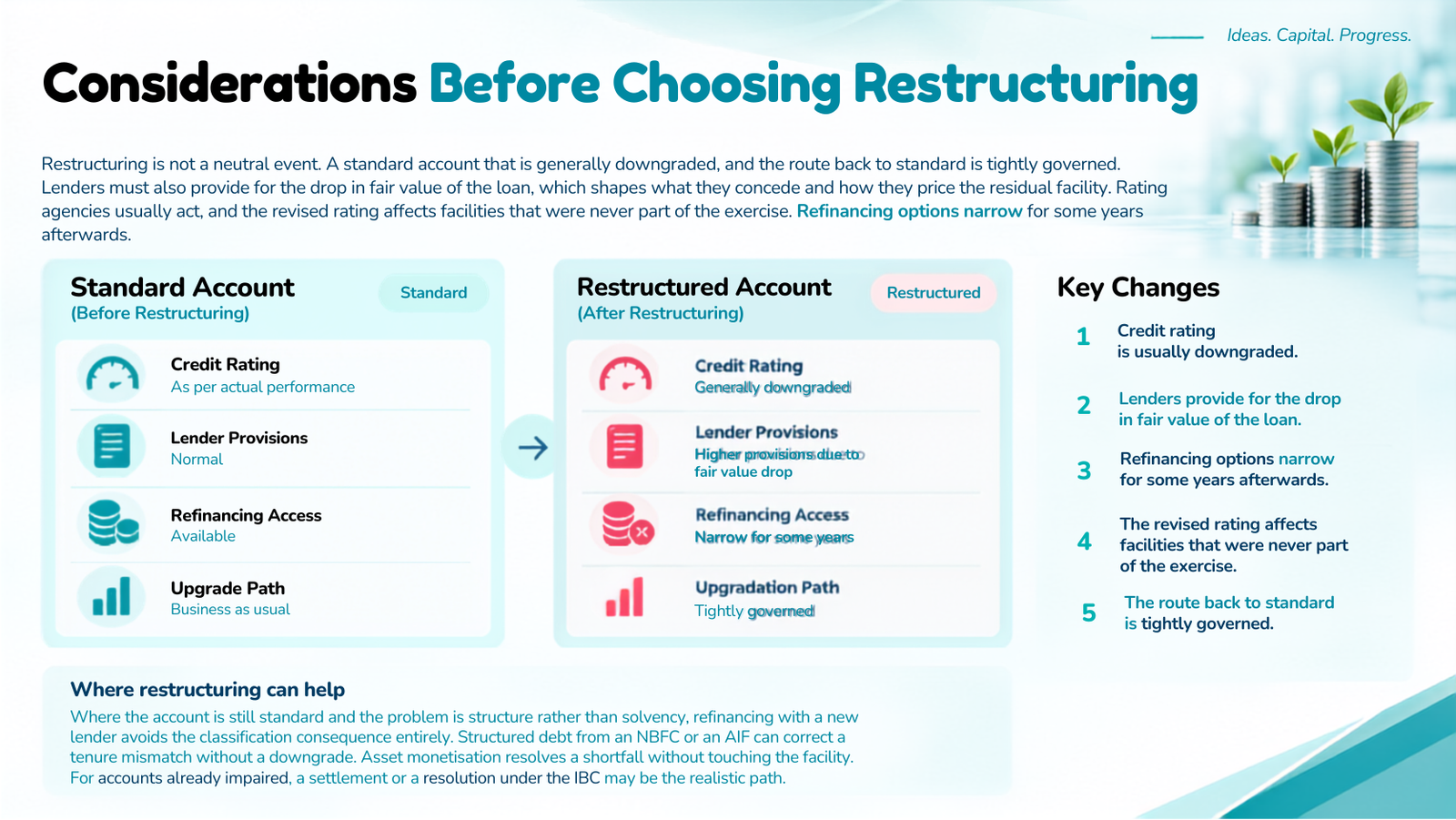
- 1Credit rating is usually downgraded.
- 2Lenders provide for the drop in fair value of the loan.
- 3Refinancing options narrow for some years afterwards.
- 4The revised rating affects facilities that were never part of the exercise.
- 5The route back to standard is tightly governed.
Restructuring is not a neutral event. A standard account that is restructured is generally downgraded, and the route back to standard is tightly governed. Moreover, lenders must provide for the drop in fair value of the loan, which shapes what they concede and how they price the residual facility. Rating agencies usually act as well, and the revised rating affects facilities that were never part of the exercise. As a result, refinancing options narrow for some years afterwards.
When Refinancing Is a Better Route
However, where the account is still standard and the problem is structure rather than solvency, refinancing with a new lender avoids the classification consequence entirely. For instance, structured debt from an NBFC or an AIF can correct a tenure mismatch without a downgrade. Similarly, asset monetisation resolves a shortfall without touching the facility. For accounts already impaired, on the other hand, a settlement or a resolution under the IBC may be the realistic path.
The Variable Borrowers Control
Cash flow stress is visible internally months before a lender sees it. For example, stretched creditor days, drawing power falling behind utilisation, or an interest month that closes only because a promoter deposit arrived — these are the signals. Consequently, those are the months in which loan restructuring in India is easiest to negotiate, because the lender is still choosing between a workable plan and a future NPA rather than between recovery routes.
Borrowers who act inside that window keep their options. Those who wait inherit the lender’s.
Preparing the Case for Lenders
Leverest works with promoters and CFOs at the point where a restructuring case still has to be built. That usually means putting the file together in the form a credit committee expects: cash flow projections tied to actual collections, a clear account of what caused the stress, and a repayment structure the business can hold. Where refinancing is the better route, we test that appetite with lenders in parallel before the account is downgraded. We do not decide the outcome. Lenders do. Our role is to make sure the case reaching them is complete and realistic.
How the Process Runs, Step by Step
Preparing the Case for Lenders
Leverest works with promoters and CFOs at the point where a restructuring case still has to be built. That usually means putting the file together in the form a credit committee expects: cash flow projections tied to actual collections, a clear account of what caused the stress, and a repayment structure the business can hold. Where refinancing is the better route, we test that appetite with lenders in parallel before the account is downgraded. We do not decide the outcome. Lenders do. Our role is to make sure the case reaching them is complete and realistic.